
Due diligence: a trainee's role
What is due diligence?
Due diligence refers to the process under which a potential buyer and its advisors carry out an in-depth investigation into various aspects of a target company (or target group) in order to gain a solid understanding of its business and the market(s) in which it operates. The findings of this investigation are then typically set out in a “due diligence report”, which can help a potential buyer to decide whether to go ahead with a purchase and if so, at what price and on which terms.
Although there may already be a “vendor due diligence” report (explained below) in the data room, a prospective buyer will usually want its advisers to produce a supplementary due diligence report, for instance one that focuses more on specific elements that are particularly important to the prospective buyer, or elements that were not sufficiently covered in the vendor due diligence report.
The extent of the due diligence carried out will typically depend on the value of the target, the deal timetable, the client’s instructions/budget, the type of business operated by the target, the nature/value of the target’s assets, and the extent to which the seller is willing to give warranties to cover certain risks (the concept of warranties is explained in more detail below). However, sometimes it may simply not be economical for a buyer to scrutinise every part of a target business.
Vendor due diligence
Vendor due diligence refers to the process under which a seller and its advisers carry out an investigation into the company (or group of companies) that the seller is intending to sell. The findings of this investigation are then typically set out in a “vendor due diligence” report. Vendor due diligence reports usually focus on “red flags” (i.e. key issues or concerns) that are likely to affect potential bidders. On the basis of these reports, bidders may then decide to simply seek clarifications or ask follow-up questions, carry out their own supplementary due diligence, or walk away from the deal.
Vendor due diligence generally serves two key purposes:
1. It can speed up the sale process.
This is especially the case in an auction scenario, as making a vendor due diligence report available to multiple bidders reduces the level of due diligence that each bidder will need to carry out independently, whilst ensuring that the target’s management team (and legal advisers) need not repeatedly answer identical questions from different prospective bidders.
2. The process can enable a seller and its advisers to identify at an early stage any issues that may subsequently come to light and affect the deal.
This can ensure that the seller and its advisers are sufficiently informed to answer many of the questions that bidders will inevitably ask throughout the process, whilst also giving the seller the opportunity to rectify issues in advance (which can reduce the risk of prospective bidders walking away from the deal or attempting to negotiate a lower purchase price).
In addition, by producing a vendor due diligence report and making it available to prospective bidders, the seller is essentially formally disclosing information about its business. This can be important when the main transactional documents are negotiated further down the line, as the seller will likely be expected to make certain blanket statements about the state of its business (e.g. “the target company is not currently a party to any litigation”), but will usually be permitted to qualify these statements by making them subject to certain disclosures.
Data rooms
When carrying out DD or VDD, companies – or more typically, their advisers – carry out their investigations on the basis of documents that are uploaded to “data rooms” (to which only select parties will be granted access). Historically, data rooms were actual rooms filled with physical files and boxes of documents, but nowadays data rooms are online databases where documents are uploaded, removed and amended as part of what is usually quite a dynamic process.
Data rooms usually contain comprehensive information about a target company that is or might be relevant to the transaction, including: its ownership structure, capital and assets (including intellectual property and real estate), financing arrangements, employment arrangements and commercial arrangements (including customer and supplier contracts, licenses etc.), as well as details of any outstanding liabilities or legal proceedings (e.g. pending litigation or regulatory investigations).
The documents uploaded to a data room can therefore help buyers to understand in greater detail the company or assets that they are considering purchasing, whilst providing their advisers with the opportunity to discover (and subsequently deal with) any existing risks or issues. This is important, as the findings may well impact upon the perceived value of the business, which can influence the price, terms and structure of the transaction.
Seller protection
Sellers will want to ensure that potential buyers (which may well also be existing competitors) cannot use to their own advantage any information discovered if the deal doesn’t go ahead. Sellers will therefore require prospective buyers to sign a non-disclosure agreement before granting them access to a data room. This is because (as previously mentioned), a non-disclosure agreement can restrict not only the recipient’s ability to disclose the information it has accessed, but also the purposes for which that information may be used by the recipient.
Sellers may also restrict the amount of information about its businesses that goes into the data room, for instance through redacting documents, password protecting documents, or only granting access to the most sensitive information once the sale process is much further along.
How does due diligence fit into the deal process?
There are various ways in which the buyer can limit the amount of due diligence it needs to carry out, whilst still protecting its position. As explained earlier, warranties (statements of existing fact), undertakings (promises to take certain action in the future) and indemnities (promises to reimburse the other party if certain costs arise) can be given by the seller in the sale contract to mitigate risks that have been identified by the buyer. Breaches of these can result in the seller having to pay damages (i.e. compensation) to the buyer.
However, it’s worth remembering that these contractual protections are never absolute. For example, it may later transpire that the seller has breached the contract (e.g. if one of its warranties was untrue or it failed to adhere to an undertaking) or circumstances have arisen that entitle the buyer to make a claim in connection with an indemnity given by the seller. All being well, the buyer could sue the seller and recover any related losses. But what if the seller has entered into insolvency in the meantime (or becomes insolvent after being successfully sued, but before paying damages to the buyer)? In such a scenario, it’s unlikely the buyer would be able to recover its losses.
It’s therefore important for buyers to strike a balance between relying on contractual protections (in part, to minimise the extent of the due diligence it needs to carry out) and identifying and dealing directly with risks and issues before going ahead with the purchase.
Managing the due diligence process
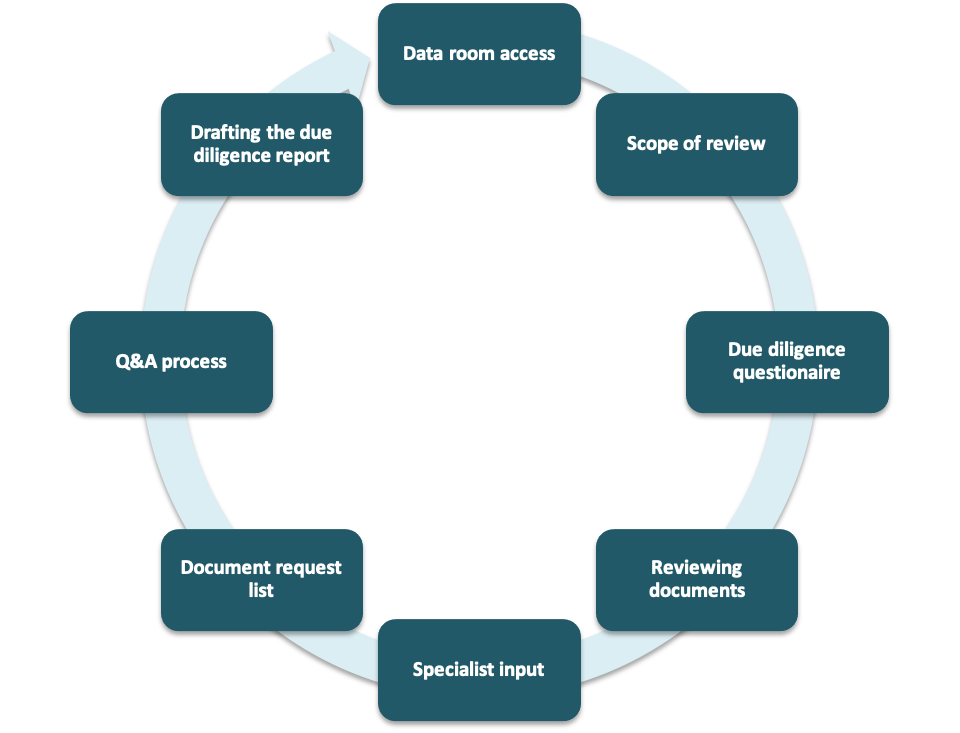
The due diligence process is typically managed by corporate trainees and junior associates, and typically involves:
- Setting up, managing and coordinating access to data rooms.
- Drafting the due diligence “scope of review”.
- Sending out the due diligence questionnaire (if on the buy-side).
- Coordinating specialist teams, local counsel and junior reviewers (e.g. paralegals/legal assistants).
- Project managing a variety of work streams, including the document request process and the Q&A process.
- Reviewing documents and filling out review templates.
- Drafting (and proofreading) the due diligence report, including collating input from other teams/third parties.
Local counsel: this is the term generally used for firms/lawyers in foreign jurisdictions who are advising on foreign law aspects of a deal (not to be confused with “counsel”, which is the term used for barristers in a litigation context).
Note that our Training Contract Handbook provides a much more comprehensive insight into the due diligence process.