Section 5: Arguments
What does the arguments section of a Watson Glaser test assess?
The arguments section of a Watson Glaser test assesses your ability to evaluate the relevance and strength of arguments.
You'll be presented with a series of questions, each of which is followed by a “yes” or “no” answer, as well as a proposed argument to support that yes or no answer. You must then determine whether that proposed argument is weak or strong (i.e. you must assess whether the argument provides strong support for the “yes” or “no” answer given).
You must regard the information contained within each argument to be objectively true - even if you do not believe this to be the case in reality, and even if the argument goes against your intuition or personal beliefs – then decide whether each argument sufficiently supports the proposed answer to the question.
What makes an argument strong?
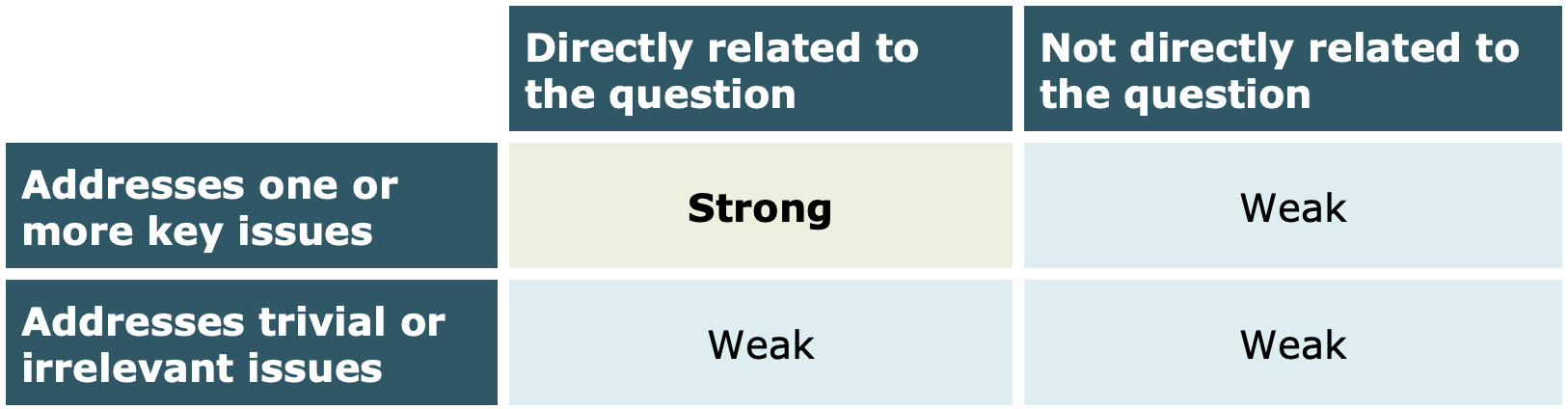
For an argument to be strong, it must be important (i.e. it must address the key issue being discussed/go to the heart of the question) and it must directly relate to the question.
An argument is weak if it does not directly relate to the question (even though it may be of significant general importance), if it is of only minor importance, or if it is directly related to only trivial aspects of the question.
An argument can still be strong even if that argument alone wouldn’t necessarily be enough to conclusively determine the answer to the question, or if other (arguably even stronger) arguments exist in favour of or against whatever is being proposed.